
Why Sleep Gets Harder During Menopause (And What Actually Helps)
For many women, sleep problems during perimenopause and menopause arrive almost overnight — a stretch of life where sleep had been reasonably reliable suddenly becomes anything but. Night sweats, racing thoughts at 3 a.m., and a general sense that your body’s internal thermostat and clock have both gone haywire. If this sounds familiar, understanding what’s actually happening hormonally can make the experience feel less confusing — and points toward what genuinely helps.
The Hormonal Shift Behind It
Menopause involves a significant decline in estrogen and progesterone, and both hormones play meaningful, direct roles in sleep regulation — not just in reproductive health, as they’re often narrowly framed.
Estrogen helps regulate body temperature and plays a role in serotonin production, which in turn feeds into your body’s natural melatonin synthesis. As estrogen declines, both temperature regulation and the serotonin-melatonin pathway can become less stable.
Progesterone has a mild, naturally calming effect on the nervous system, partly through its interaction with GABA receptors — the same calming neurotransmitter system that plays a central role in relaxation and sleep onset. As progesterone drops, many women notice a corresponding increase in nighttime anxiety, restlessness, or a general sense of being “wired” at bedtime in a way that didn’t happen before.
Why Night Sweats Specifically Disrupt Sleep
Hot flashes and night sweats are one of the most disruptive menopause-related sleep symptoms, and it’s not just the discomfort itself — it’s the disruption to sleep architecture that matters most. Waking up overheated, even briefly, pulls you out of deeper sleep stages and back toward lighter, more easily disrupted sleep. If this happens multiple times a night, it prevents the kind of sustained deep sleep your body needs for physical and cognitive recovery, even if your total time in bed hasn’t changed.
The Anxiety Connection
Many women going through menopause describe a new or intensified pattern of nighttime anxiety — racing thoughts, a mind that won’t settle, or a general sense of unease at bedtime that wasn’t previously part of their sleep experience. This tracks directly with the progesterone decline mentioned earlier: since progesterone has a natural calming effect partly through GABA receptor activity, its reduction can leave the nervous system less naturally buffered against stress and overactivity, particularly at night when there are fewer daytime distractions competing for attention.
Why Standard Melatonin Alone Often Falls Short Here
This is a case where a single-ingredient melatonin supplement frequently underperforms, and understanding why is useful. Melatonin addresses circadian timing — the “it’s nighttime” signal — but it does very little for temperature regulation or the anxious, overactive nervous system pattern that’s specifically tied to declining progesterone. A woman whose menopause-related sleep disruption is primarily driven by nighttime anxiety and racing thoughts may find that melatonin alone barely touches the actual problem, since it isn’t the mechanism driving her particular sleep disruption.
Find out how to have a good sleep with this method!
What Tends to Help More
Supporting the nervous system directly, not just circadian timing. Since declining progesterone reduces natural GABA-related calming, supplementing with ingredients that support that same calming pathway — GABA itself, along with L-theanine, which promotes relaxed alpha brain wave activity without sedation — can help fill some of that gap more directly than melatonin alone.
Supporting serotonin balance. Since estrogen decline affects the serotonin pathway that feeds into natural melatonin production, ingredients like 5-HTP (a direct serotonin precursor) combined with vitamin B6 (which supports the conversion of 5-HTP into serotonin) can help support this disrupted pathway more directly than melatonin supplementation alone.
Keeping the sleep environment cool. Given how disruptive night sweats are to sleep continuity, environmental temperature control matters more during this life stage than almost any other. Breathable bedding, a cooler room temperature than you might have previously preferred, and moisture-wicking sleepwear can meaningfully reduce the frequency and severity of sleep-disrupting overheating episodes.
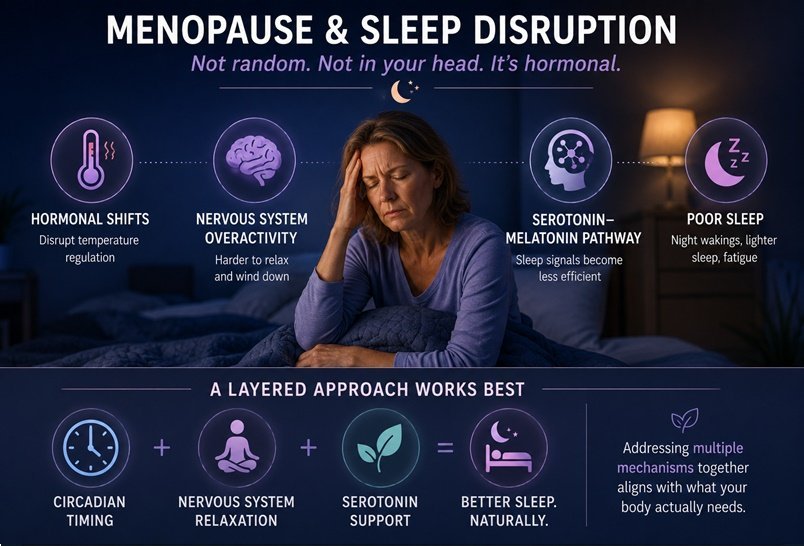
A layered, multi-ingredient approach rather than a single hormone. Given that menopause-related sleep disruption typically involves several overlapping mechanisms — temperature regulation, serotonin/melatonin pathway disruption, and reduced natural GABA activity — a formula addressing multiple angles at once tends to be more relevant than a single-ingredient product. This is part of why a combination formula like YuSleep, which pairs melatonin and red tart cherry extract for circadian support with GABA and L-theanine for nervous system calm, and 5-HTP with B vitamins for serotonin support, is designed to address more of the actual mechanisms at play during this stage, rather than relying on melatonin alone to do all the work.
What About Hormone Replacement Therapy?
For some women, hormone replacement therapy (HRT) is an appropriate and effective option for managing menopause symptoms, including sleep disruption, and should be discussed with a doctor as part of a broader menopause management conversation. A natural sleep supplement isn’t a substitute for HRT if HRT is medically appropriate for you — but for women who aren’t candidates for HRT, prefer not to pursue it, or want additional support alongside it, addressing the nervous system and serotonin pathways directly through a formula like this can still provide meaningful benefit.
Lifestyle Adjustments Worth Making
Reassess alcohol timing, if you drink. Alcohol can worsen both hot flashes and sleep fragmentation, and many women find that menopause-related sleep sensitivity to alcohol increases compared to earlier in life, even at amounts that were previously well-tolerated.
Watch caffeine more carefully. Similarly, caffeine sensitivity often increases during this life stage. A caffeine habit that was fine in your 30s may need adjusting if you’re now noticing it more directly affecting sleep or anxiety levels.
Prioritize consistent sleep-wake timing. Given how much is already being disrupted hormonally, keeping the pieces you can control — consistent sleep and wake times — steady helps provide some stability for your circadian rhythm during a period when internal signals are less predictable than before.
A Note on Individual Variation
Menopause symptoms and their severity vary enormously between individuals, and what helps one woman may need adjustment for another. If sleep disruption is severe, persistent, or significantly affecting your quality of life, it’s worth a dedicated conversation with your doctor — menopause-related sleep issues are common, well-recognized, and worth addressing directly rather than assuming they simply have to be endured.
Final Thoughts
Sleep disruption during menopause isn’t random or purely psychological — it’s driven by specific, identifiable hormonal changes affecting temperature regulation, nervous system calm, and the serotonin-melatonin pathway simultaneously. Because multiple mechanisms are typically involved at once, a layered approach addressing circadian timing, nervous system relaxation, and serotonin support together tends to align more closely with what’s actually happening in the body during this stage than a single-ingredient melatonin product alone.
Find out how to have a good sleep with this method!
These statements have not been evaluated by the FDA. This product is not intended to diagnose, treat, cure, or prevent any disease. Always consult your doctor about menopause symptom management, including whether hormone replacement therapy or other treatments may be appropriate for you.