How Much Is Bad Sleep Actually Costing You Every Year?
Poor sleep doesn’t send you a bill. There’s no line item on a monthly statement labeled “cost of exhaustion.” But that doesn’t mean it’s free — it’s just a cost that’s spread out, hidden, and easy to underestimate until you actually sit down and add it up. This article does exactly that: a real, numbers-based look at what chronic poor sleep is likely costing you every year, and how that compares to the cost of actually fixing it.
The Productivity Cost
Research on sleep and workplace performance consistently points to the same conclusion: poor sleep measurably reduces output, focus, and decision-making quality. Even conservative estimates suggest that a chronically sleep-deprived employee loses the equivalent of several full workdays per year in reduced productivity — time spent physically present but mentally underperforming.
If you’re paid hourly or salaried and can estimate your effective hourly value, even a modest 10% productivity reduction across a 2,000-hour work year adds up to roughly 200 hours of reduced output annually. For someone earning $30/hour, that’s a rough equivalent of $6,000 a year in lost productive value — value you’re not capturing even though you’re putting in the time.
The Caffeine Tax
Chronic poor sleep tends to come with an unofficial caffeine dependency, whether that’s coffee, energy drinks, or both. A daily $5 coffee habit — often more, once you add a second afternoon cup to fight the inevitable crash — adds up to roughly $1,800 a year for many people. And this is often caffeine used specifically to compensate for poor sleep, rather than simple enjoyment, meaning it’s a direct downstream cost of the underlying sleep problem.
The Healthcare Cost
Chronic sleep deprivation is associated with increased risk for a range of health issues, including weakened immune function, higher susceptibility to illness, and increased long-term risk for several chronic conditions. Even setting aside long-term risk, the more immediate cost shows up in smaller ways: more frequent minor illnesses, more sick days, and more visits to a doctor for stress- or fatigue-related symptoms. It’s difficult to put a precise number on this category, but even a conservative estimate of one or two extra sick days a year, combined with related out-of-pocket healthcare costs, easily adds several hundred dollars annually for many people.
The “Bad Decision” Cost
This one is harder to quantify but arguably one of the most expensive. Sleep-deprived decision-making has been linked in research to poorer judgment, increased impulsivity, and reduced ability to weigh long-term consequences. In practical terms, this can show up as impulse purchases, costly mistakes at work, or simply making a worse version of a decision you would have made more carefully if you’d been properly rested. Even one avoidable financial misstep a year, easily explainable by fatigue-driven poor judgment, can outweigh the cost of addressing the sleep problem directly.
The Relationship and Time Cost
Chronic exhaustion tends to shorten patience and reduce the quality of time spent with the people around you. While this doesn’t have a direct dollar figure, it has a very real opportunity cost — less quality time, more friction in relationships, and less capacity to actually enjoy the parts of life that sleep-deprived people are often too tired to fully engage with. It’s the cost that doesn’t show up on paper but is arguably the most significant of all.
Adding It Up
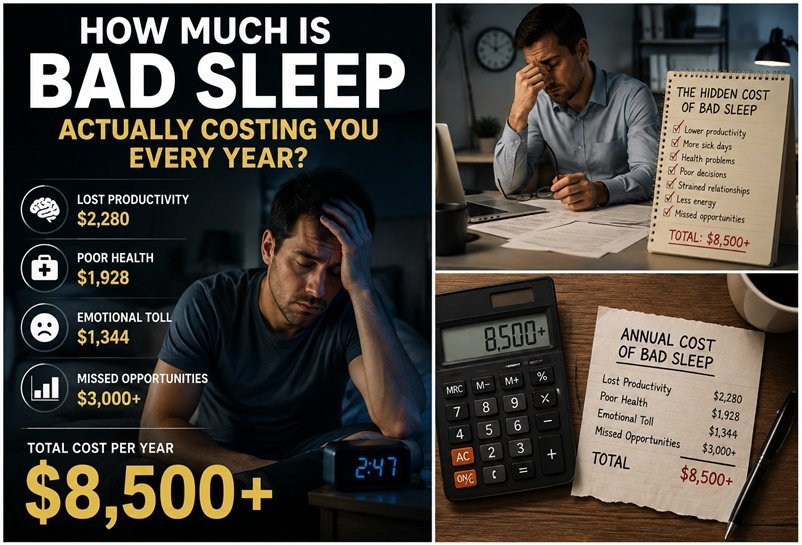
Even using conservative, back-of-envelope estimates, chronic poor sleep can realistically cost:
- ~$6,000/year in reduced work productivity (at a modest hourly value)
- ~$1,800/year in compensatory caffeine spending
- ~$300–500/year in additional sick days and related healthcare costs
- Unmeasured but real costs in decision quality, relationship strain, and diminished quality of life
That’s a rough total in the range of $8,000–$9,000 a year — and this doesn’t even account for longer-term health risks associated with chronic sleep deprivation, which carry their own high, if harder-to-quantify, cost.
Now Compare That to the Cost of Actually Addressing It
Against that backdrop, the cost of a genuine attempt at fixing the underlying problem looks considerably smaller. YuSleep’s pricing, for context:
- 2 Bottles (60-day supply): $138 + shipping — about $2.30/day
- 3 Bottles (90-day supply): $177 total — about $1.97/day
- 6 Bottles (180-day supply): $234 total — about $1.30/day
Annualized, even the smallest package works out to roughly $840/year if used continuously — and the largest package brings that down closer to $475/year. Compared to a realistic $8,000+ annual cost of unresolved chronic poor sleep, the math isn’t particularly close.
Why This Framing Matters
It’s easy to think of a sleep supplement as a discretionary expense — something nice to have, but not essential. Reframing it against the actual, ongoing cost of poor sleep tells a different story: it’s less “an extra $60 a month” and more “a fraction of what unresolved bad sleep is quietly costing you already, just distributed in ways that don’t show up on a single bill.”
This is also part of why a 60-day money-back guarantee matters more than it might initially seem. It effectively removes the financial risk of finding out whether addressing the root problem — rather than continuing to absorb its ongoing, distributed cost — actually works for you.
A Simple Way to Do Your Own Math
If you want to run your own numbers, a rough framework looks like this:
- Estimate productivity loss: (Your hourly rate) × (Estimated % productivity reduction, often 10–20% for chronic poor sleepers) × (Annual work hours)
- Add compensatory spending: Daily caffeine/energy drink cost × 365
- Add estimated healthcare costs: Extra sick days × daily income lost, plus any related out-of-pocket costs
- Consider (even if you can’t fully quantify) decision-quality and relationship costs
Most people who run this exercise honestly are surprised by how large the number gets — and how small the cost of a genuine attempt at fixing it looks by comparison.
Final Thoughts
Bad sleep isn’t free. It’s just billed in a currency that doesn’t show up as a single line item — lost productivity, compensatory caffeine spending, extra sick days, and diminished decision quality, spread quietly across the year. When you actually add it up, the cost of a well-formulated natural sleep supplement, even at a premium price point, tends to look less like an indulgence and more like one of the more cost-effective investments available for addressing a problem that’s already costing you far more than you may have realized.
Find out how to save your money with this sleep method!
Cost estimates are illustrative and will vary significantly based on individual circumstances. These statements have not been evaluated by the FDA. This product is not intended to diagnose, treat, cure, or prevent any disease.