
The 20-Minute Evening Ritual Inspired by Japanese Sleep Culture
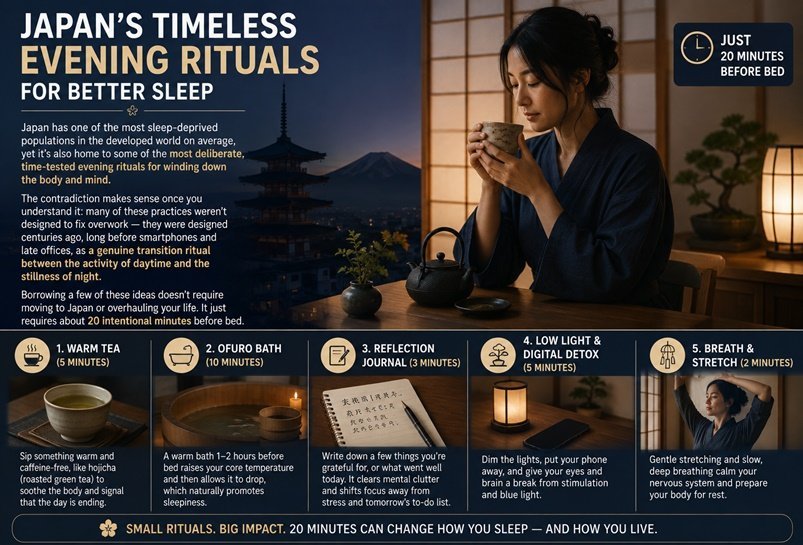
Japan has one of the most sleep-deprived populations in the developed world on average, yet it’s also home to some of the most deliberate, time-tested evening rituals for winding down the body and mind. The contradiction makes sense once you understand it: many of these practices weren’t designed to fix overwork — they were designed centuries ago, long before smartphones and late offices, as a genuine transition ritual between the activity of daytime and the stillness of night. Borrowing a few of these ideas doesn’t require moving to Japan or overhauling your life. It just requires about 20 intentional minutes before bed.
Why a Structured Ritual Works Better Than “Just Relaxing”
One of the underlying ideas in Japanese wellness culture is the concept of a clear, repeated sequence marking the transition from one state to another — a practice reflected in everything from the tea ceremony to the structure of a traditional bath routine. The specific steps matter less than the fact that they’re consistent and repeated. Your nervous system responds well to predictable patterns; a repeated sequence effectively becomes a cue, training your body to recognize “this sequence means it’s time to wind down,” much the way a consistent bedtime routine helps children learn to fall asleep more easily.
Here’s a 20-minute version built around that same principle, adapted for a modern evening routine.
Minutes 1–5: The Bath or Warm Shower Ritual (Ofuro-Inspired)
In Japan, bathing before bed is traditionally treated as a distinct ritual from bathing to get clean — a practice known as ofuro, typically done in the evening specifically to relax the body before sleep, separate from the practical washing that happens beforehand. The warm water itself plays a physiological role: raising your body temperature slightly and then allowing it to drop afterward mimics the natural temperature decline your body undergoes as it prepares for sleep, which can help signal drowsiness.
How to adapt it: You don’t need a traditional soaking tub. A warm shower or bath, 5 minutes long, taken specifically as a “winding down” ritual rather than your morning or daytime wash, captures much of the same effect. The key is timing it roughly an hour before bed, giving your body temperature time to drop afterward — that temperature drop is part of what helps trigger natural sleepiness.
Minutes 6–10: A Quiet, Deliberate Tea Ritual
The structured, unhurried nature of a traditional tea ritual reflects a broader cultural value around slowing down and being fully present in a simple, repeated act — precisely the opposite of the rushed, multitasking pace most people carry into their evenings. Beyond the ritual itself, chamomile or other caffeine-free herbal tea has a long history of use specifically for evening relaxation.
How to adapt it: Make a cup of caffeine-free tea — chamomile, valerian root tea, or a simple herbal blend — and drink it slowly, without your phone in hand. The goal isn’t just the tea itself; it’s the five minutes of doing one single, unhurried thing with your full attention, which is a rare experience in most modern evenings.
Minutes 11–15: Tidying a Small Space (Inspired by the Value Placed on Order)
There’s a well-documented cultural emphasis in Japan on tidiness and order as a form of respect for your space and, by extension, your own peace of mind. A cluttered bedroom has been associated in sleep research with a small but real negative effect on sleep quality, likely because visual clutter keeps the mind subtly more alert and unsettled.
How to adapt it: Spend five minutes doing a small, calm tidy of your bedroom — putting away clothes, clearing your nightstand, straightening your bed. This isn’t about deep cleaning; it’s a brief, repeated act that signals order and closure to the day, and it leaves you walking into a genuinely restful-feeling space rather than a visually chaotic one.
Minutes 16–20: Stillness Without a Screen
The final stretch of the ritual borrows from a broader idea found across many Japanese wellness practices: the value of brief, intentional stillness — a few minutes of quiet breathing, gentle stretching, or simply sitting without any stimulation, distinct from the constant engagement most people default to in idle moments.
How to adapt it: Spend your final five minutes before getting into bed doing something screen-free and calm — light stretching, a few minutes of slow breathing, or simply sitting quietly. This is also the ideal window to take a nightly sleep supplement like YuSleep, if you use one, since its ingredients — melatonin, GABA, L-theanine — are designed to work best when paired with an already calming pre-bed environment rather than a stimulating one.
Find out how this sleep formula can help you sleep naturally!
Why the Order Matters
Notice that this ritual moves from more active (bathing) to progressively quieter (tidying, then stillness) — mirroring your body’s own natural transition into sleep. Doing these steps in reverse, or cramming them into a rushed five minutes right before bed, tends to be far less effective than following a consistent, unhurried sequence.
Putting It All Together: A Simple 20-Minute Sequence
- Minutes 1–5: Warm shower or bath, done as a deliberate wind-down ritual
- Minutes 6–10: Caffeine-free tea, consumed slowly, phone-free
- Minutes 11–15: A brief, calm tidy of your bedroom space
- Minutes 16–20: Screen-free stillness — light stretching, slow breathing, or quiet sitting; take your sleep supplement during this window if you use one
Why This Kind of Ritual Pairs Well With a Natural Sleep Supplement
A structured wind-down ritual and a formula like YuSleep are solving complementary parts of the same problem. The ritual addresses your environment and behavior — reducing stimulation, creating consistency, physically preparing your body for the temperature drop associated with sleep onset. The supplement addresses the internal biological side — supporting melatonin levels, calming an overactive nervous system with GABA and L-theanine, and supporting serotonin balance with 5-HTP. Neither fully replaces the other; together, they tend to produce noticeably better results than either alone.
Final Thoughts
You don’t need to adopt an entirely new cultural framework to benefit from these ideas — just the underlying principle behind them: a consistent, unhurried, screen-free sequence that clearly marks the transition from your day into your night. Twenty minutes is a small investment against the cost of another restless night, and pairing that ritual with a natural sleep formula designed to support the same wind-down process internally tends to be one of the more effective combinations for genuinely better sleep.
Find out how this sleep formula can help you sleep naturally!
These statements have not been evaluated by the FDA. This product is not intended to diagnose, treat, cure, or prevent any disease. Individual results may vary.